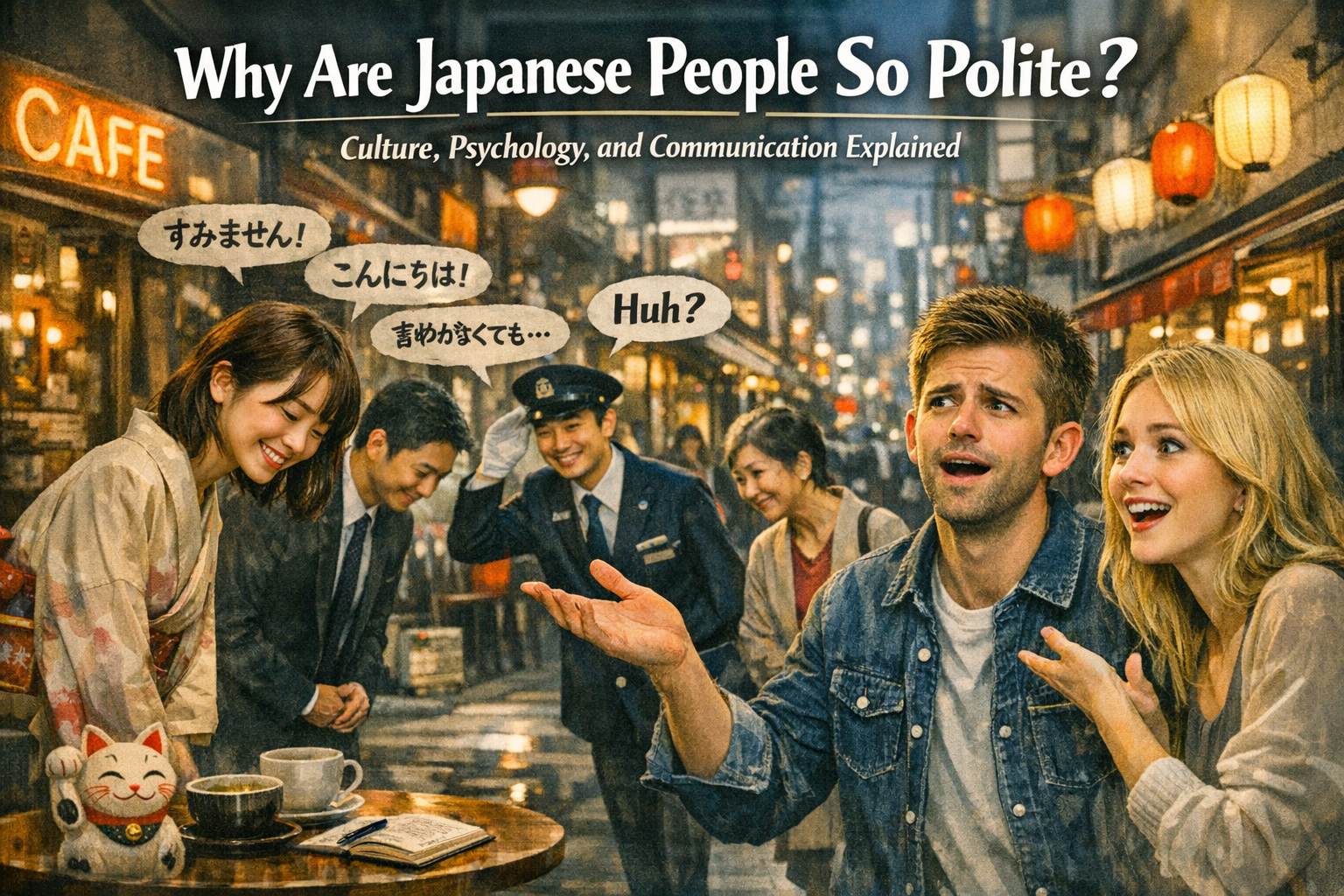
- Introduction: The Hidden Reason Behind Japanese Politeness
- 1. Politeness as Social Survival
- 2. The Fear of Being Disliked
- 3. Indirect Communication
- 4. The Role of Vague Expressions
- 5. Politeness Through Language Levels
- 6. Emotional Control
- 7. Cultural Concept: “Reading the Air”
- 8. The Downside of Politeness
- 9. Is Japanese Politeness Genuine?
- Conclusion
Introduction: The Hidden Reason Behind Japanese Politeness
Japanese people are often seen as very polite.
But why is that?
As a Japanese person, I feel that politeness is not just about manners—it is deeply connected to how we think and how we relate to others.
Japanese people tend to have a stronger feeling than people in many other countries of “not wanting to be disliked by others.”
At the same time, this means that we care a lot about how others evaluate us.
If I reflect on my own thinking honestly, I realize that I often feel:
- “I want people around me to think I am kind and a good person”
👉 This mindset plays a big role in why Japanese people appear polite.
1. Politeness as Social Survival
In Japan, society places a strong emphasis on:
- Harmony
- Cooperation
- Avoiding conflict
👉 Being polite is not just “nice”
👉 It is a way to function smoothly in society
If someone is:
- too direct
- too aggressive
👉 They may be seen as:
- rude
- difficult to work with
2. The Fear of Being Disliked
This is one of the most important points.
Japanese people often:
- avoid strong opinions
- soften their language
- hesitate to say “no”
👉 Why?
👉 Because they don’t want to:
- hurt others
- damage relationships
- be judged negatively
3. Indirect Communication
Instead of saying:
- “No”
Japanese people might say:
- ちょっと難しいです
→ It’s chotto difficult
👉 This actually means:
👉 “No”
👉 Learn more:
What does “chotto” mean in Japanese?
4. The Role of Vague Expressions
Japanese uses many softening words like:
- tabun (probably)
- nanka (kind of)
Example:
- 多分大丈夫
→ It’s tabun okay
👉 This reduces responsibility and sounds softer.
👉 Learn more:

5. Politeness Through Language Levels
Japanese has clear levels of politeness:
- Casual speech
- Polite speech
- Honorific language
Example:
- ありがとう → casual
- ありがとうございます → polite
👉 Choosing the right level shows respect.
👉 Learn more:
6. Emotional Control
Japanese communication often avoids:
- strong emotions
- extreme expressions
Instead, people prefer:
- calm
- controlled
- indirect communication
Compare:
- まじですごい!
→ That’s maji amazing! (emotional) - 本当に素晴らしいです
→ That is truly wonderful (controlled)
👉 Learn more:
7. Cultural Concept: “Reading the Air”
In Japan, people are expected to:
- understand context
- notice subtle cues
- adjust their behavior
👉 This is often called:
👉 “reading the air”
Failing to do this can be seen as:
- rude
- insensitive
8. The Downside of Politeness
While politeness is valued, it also has drawbacks:
- People may hide their true feelings
- Communication can be unclear
- Decisions may take longer
👉 Sometimes, politeness creates distance instead of clarity.
9. Is Japanese Politeness Genuine?
This is a common question.
The answer is:
👉 Both yes and no
- Yes → people genuinely want harmony
- No → sometimes it is social pressure
Conclusion
Japanese politeness is not just about being kind.
It comes from:
- fear of being disliked
- concern about others’ opinions
- desire to maintain harmony
👉 Understanding this helps you understand not only the language, but also Japanese culture itself.


コメント