Conclusion
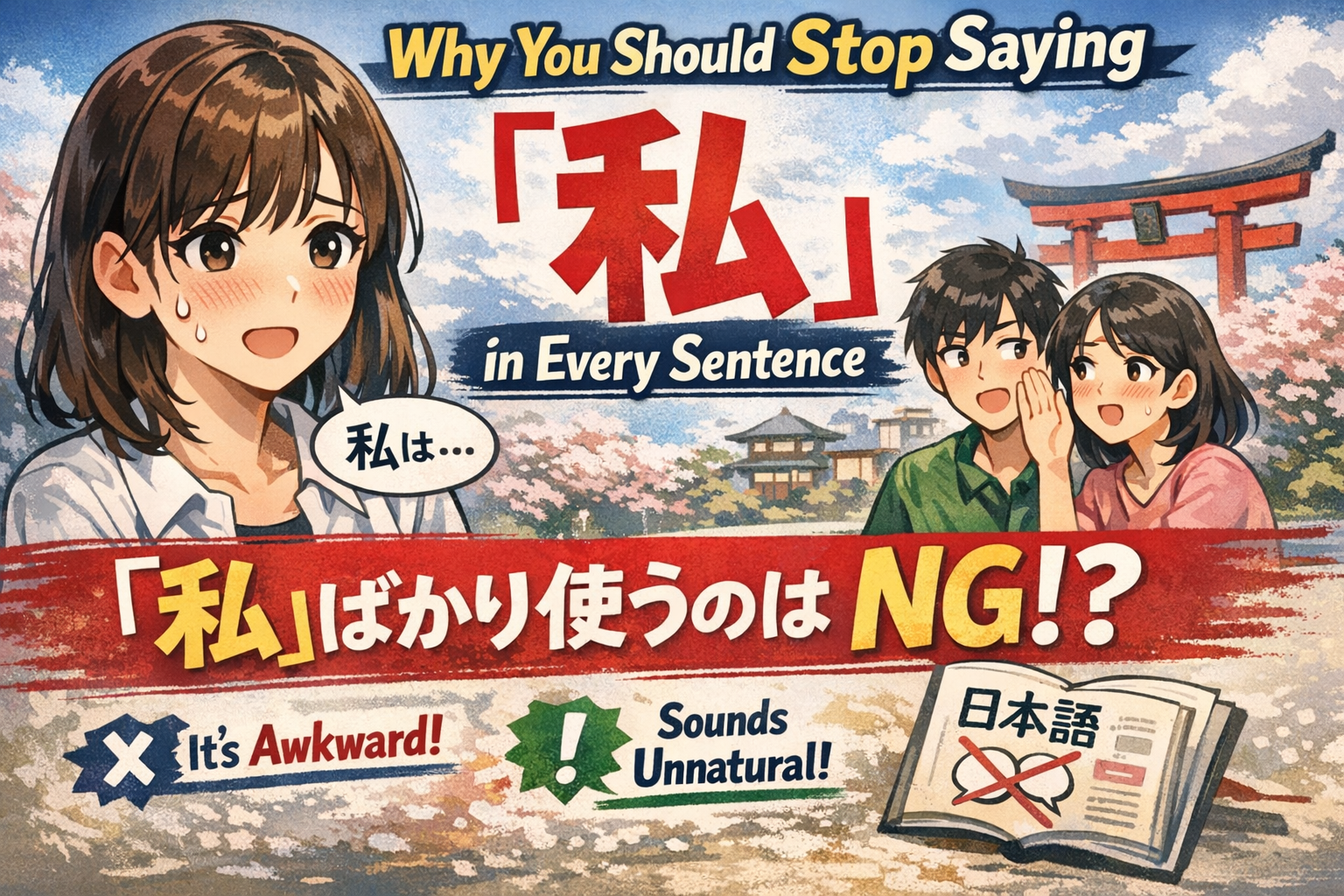
You do not need to say “watashi (私)” in every sentence. In natural Japanese conversation, the subject is often omitted when it is clear from context. Overusing “watashi” can make your speech sound repetitive or unnatural.
Many Japanese learners believe they need to say “watashi (私)” in every sentence.
However, this is one of the most common mistakes beginners make.
In natural Japanese, subjects like “I” are often omitted when they are clear from context.
As a result, overusing “watashi” can make your Japanese sound unnatural or repetitive.
If you’ve also learned that “anata (あなた)” means “you,” you might be making a similar mistake there as well.
In fact, both “watashi” and “anata” are used far less frequently in real conversation than most textbooks suggest.
In this article, you’ll learn when to use “watashi,” when to omit it, and how native speakers actually talk.

Why “Watashi (私)” Is Often Omitted
Japanese is a context-based language. This means speakers frequently drop subjects like “I,” “you,” or “they” when the meaning is already understood.
For example:
- Watashi wa ikimasu.(私は行きます。)
- Ikimasu.(行きます。)
Both mean “I will go,” but the second is more natural in most conversations.
When “Watashi” Sounds Too Repetitive
Learners often translate directly from English, where “I” is required in every sentence. This leads to sentences like:
- Watashi wa asa gohan o tabemasu.(私は朝ごはんを食べます。)
- Watashi wa shigoto ni ikimasu.(私は仕事に行きます。)
This is grammatically correct, but in real conversation, it sounds unnatural because native speakers would usually omit “watashi.”
More natural:
- Asa gohan o tabemasu.(朝ごはんを食べます。)
- Shigoto ni ikimasu.(仕事に行きます。)
Real Conversation Examples
Example 1: Casual conversation
A: Nani shiteru?(何してる?)
B: Terebi mite iru.(テレビ見ている。)
There is no “watashi,” but it is clearly understood as “I am watching TV.”
Example 2: Talking about your plans
Unnatural:
- Watashi wa ashita Tokyo ni ikimasu.(私は明日東京に行きます。)
Natural:
- Ashita Tokyo ni ikimasu.(明日東京に行きます。)
Example 3: Daily conversation flow
A: Kinou nani shita?(昨日何した?)
B: Eiga mita.(映画見た。)
Again, “I” is not needed.
When You SHOULD Use “Watashi”
“Watashi” is not wrong. It is used in specific situations.
Here is the key idea:
“Watashi” is often used in very formal situations such as job interviews or business presentations. However, in everyday conversations, it is usually not included in sentences. That said, if the subject of the sentence is unclear, it is recommended to include “watashi.”
1. Formal situations
- Watashi wa Nakamura desu.(私は中村です。)
- Watashi wa eigyou o tantou shite orimasu.(私は営業を担当しております。)
Used in:
- interviews
- presentations
- business settings
2. When the subject is unclear
Sometimes you need to clarify who is speaking.
Example:
- Watashi wa ikimasu ga, kare wa ikimasen.
(私は行きますが、彼は行きません。)
“I will go, but he will not.”
Without “watashi,” this sentence could be confusing.
3. Emphasis
When you want to emphasize “I”:
- Watashi ga yarimasu.(私がやります。)
“I will do it.”
Common Mistake
Many learners think:
“I must include ‘watashi’ to make a complete sentence.”
This is not true in Japanese. In fact, removing it often makes your Japanese sound more natural.
Key Takeaways
You do not need to say “watashi” in every sentence.
Japanese often omits subjects when they are clear.
Using “watashi” too often can sound unnatural.
Use it in formal situations or when clarity is needed.
If you want to learn more about Japanese, check below!




コメント