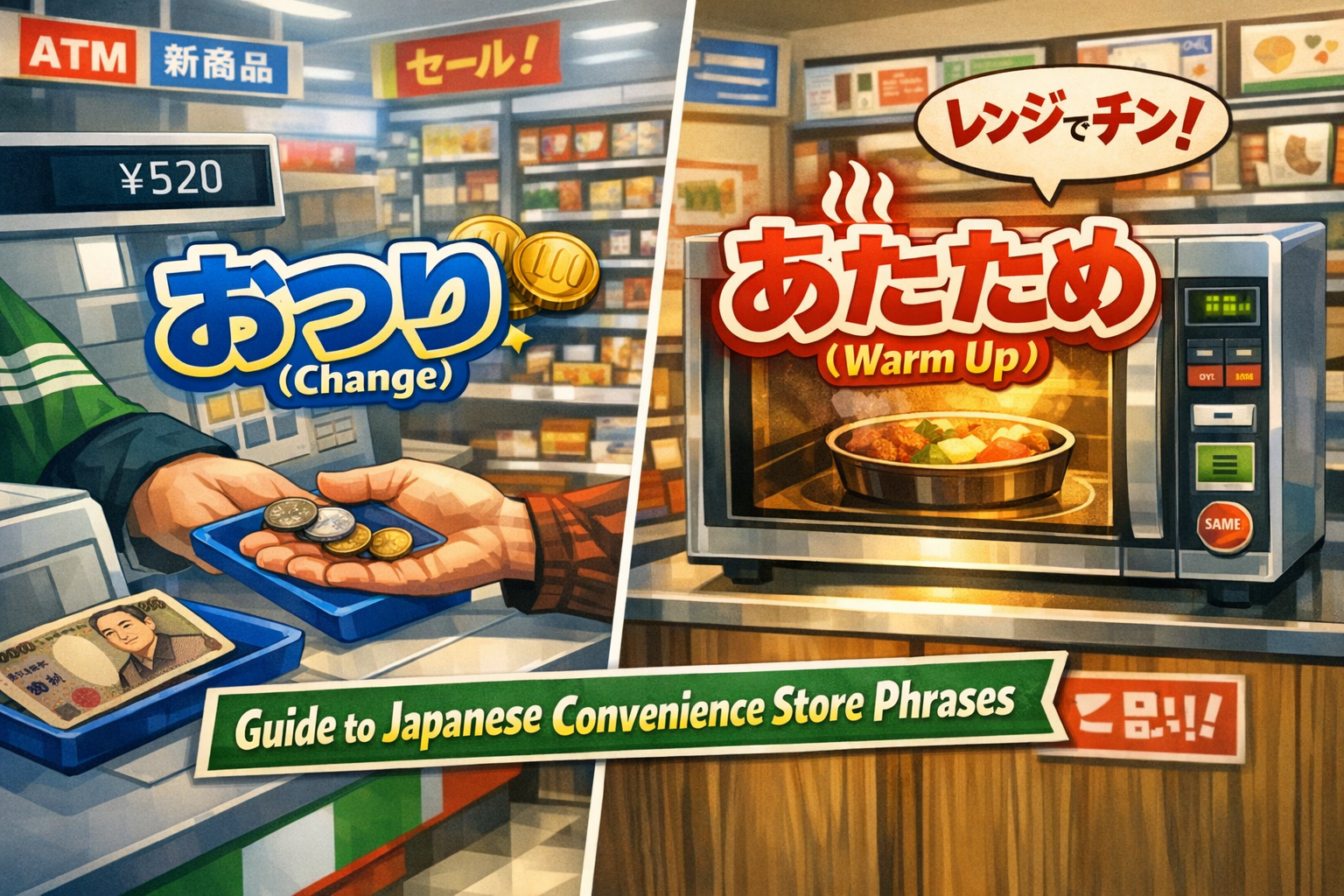
If you’re traveling in Japan, you will definitely use convenience stores like 7-Eleven, Lawson, or FamilyMart almost every day.
The good news?
You only need a few simple Japanese phrases to handle most situations smoothly.
As a Japanese person, I can tell you that convenience stores follow very standard interactions. Once you learn these phrases, you’ll feel confident and avoid awkward moments at the counter.
- ✅ Essential Japanese Phrases (Quick List)
- 1. Getting Attention – Sumimasen (すみません)
- 2. Pointing and Buying – Kore kudasai (これください)
- 3. The Most Common Question – Fukuro wa irimasu ka? (袋はいりますか?)
- 4. Heating Food – Atatamemasu ka? (温めますか?)
- 5. Saying No Politely – Daijoubu desu / Kekkou desu
- 6. Paying and Change – Otsuri (お釣り)
- 7. Always End with Thank You – Arigatou gozaimasu (ありがとうございます)
- 💡 Real Experience from a Japanese Perspective
- ✅ Conclusion
✅ Essential Japanese Phrases (Quick List)
Here are the must-know phrases you’ll actually hear and use at convenience stores in Japan:
- Sumimasen (すみません) – Excuse me / Get attention
- Kore kudasai (これください) – This one, please
- Fukuro wa irimasu ka? (袋はいりますか?) – Do you need a bag?
- Daijoubu desu (大丈夫です) – No, I’m okay / I don’t need it
- Atatamemasu ka? (温めますか?) – Should I heat it?
- Hai, onegaishimasu (はい、お願いします) – Yes, please
- Kekkou desu (結構です) – No, thank you
- Otsuri (お釣り) – Change (money)
- Arigatou gozaimasu (ありがとうございます) – Thank you
💡 These phrases cover almost everything: buying food, answering staff questions, and paying.
1. Getting Attention – Sumimasen (すみません)
If you need help, just say sumimasen.
Japanese perspective:
We use this all the time — not only to apologize, but also to politely call staff.
Example:
- Sumimasen – Excuse me
👉 Use this when:
- You can’t find something
- You want to ask a question
2. Pointing and Buying – Kore kudasai (これください)
This is the easiest way to buy something. Just point and say it.
Example:
- Kore kudasai – This one, please
Japanese perspective:
Even Japanese people use this often. No need for complicated sentences.
Learn more about “sumimasen”↓

3. The Most Common Question – Fukuro wa irimasu ka? (袋はいりますか?)
At the register, staff will almost always ask this.
Meaning:
- Do you need a bag?
How to respond:
- Hai, onegaishimasu (はい、お願いします) – Yes, please
- Daijoubu desu (大丈夫です) – No, I’m okay
Japanese perspective:
Because of environmental policies, many people say daijoubu desu and bring their own bags.
4. Heating Food – Atatamemasu ka? (温めますか?)
If you buy bento or pasta, you’ll hear this.
Meaning:
- Would you like it heated?
Responses:
- Hai, onegaishimasu – Yes, please
- Kekkou desu – No, thank you
Real tip:
If you don’t understand the question, just listen for “atatame” — it means heating.
5. Saying No Politely – Daijoubu desu / Kekkou desu
These are very useful.
- Daijoubu desu (大丈夫です) – I’m okay / No thanks
- Kekkou desu (結構です) – No thank you (more formal)
Japanese perspective:
We often use indirect expressions. Daijoubu desu can mean “no,” depending on context.
6. Paying and Change – Otsuri (お釣り)
When you pay with cash, you might hear:
- Otsuri desu – Here is your change
You don’t need to say anything special — just smile and say:
- Arigatou gozaimasu (ありがとうございます) – Thank you
7. Always End with Thank You – Arigatou gozaimasu (ありがとうございます)
This is the easiest way to leave a good impression.
Japanese perspective:
Even a small “thank you” with a smile makes interactions warmer.
💡 Real Experience from a Japanese Perspective
As someone living in Japan, I often see travelers at convenience stores looking confused — especially when staff ask multiple questions quickly.
But here’s the truth:
👉 The conversation is always almost the same.
Once you understand:
- Bag?
- Heat it?
- Payment?
You can handle everything.
✅ Conclusion
You don’t need perfect Japanese to use convenience stores in Japan.
Just remember these key phrases:
- Sumimasen
- Kore kudasai
- Daijoubu desu
- Onegaishimasu
- Arigatou gozaimasu
With these, you can confidently shop at any convenience store in Japan.
💡 Pro Tip:
Listen carefully to staff questions — they follow patterns. Once you recognize them, your experience becomes much easier.

コメント