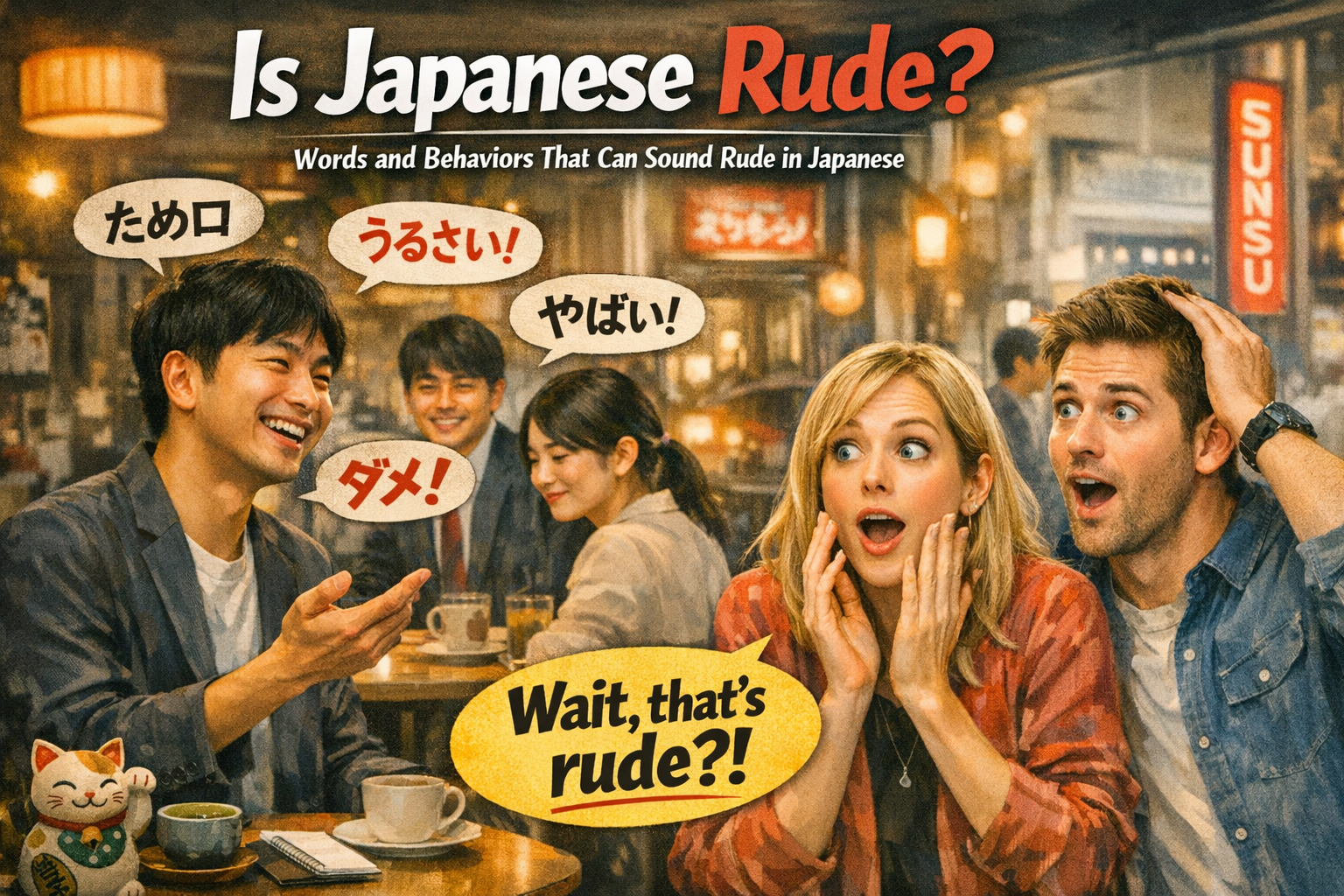
Introduction: “Rude” in Japanese Is About Tone and Context
Japanese is often considered a polite language.
However, depending on tone, context, and delivery, even simple words can sound rude.
In this article, we’ll look at:
- Words that can sound rude in Japanese
- Why they feel rude
- Behaviors Japanese people dislike
👉 Understanding this will help you avoid sounding unintentionally rude.
To better understand why some expressions sound rude, it’s important to learn how Japanese nuance works:


1. Words That Can Sound Rude in Japanese
① 「なに?」 (Nani?)
・なに?
→ Nani? (What?)
This depends heavily on how you say it.
👉 If you say it:
- shortly
- sharply
- without expression
It can sound rude, like:
- “What?” (annoyed tone)
However:
👉 If you say it with:
- a smile
- a soft tone
It becomes natural and not rude.
In Japanese, tone changes meaning significantly. To understand emotional nuance, see:
② 「だから」 (Dakara)
・だから言ったじゃん
→ I told you, dakara
This is a normal Japanese word, but:
👉 It can sound:
- impatient
- slightly aggressive
Safer alternatives:
- ですので → therefore (formal)
- なので → so / therefore (softer)
👉 Small changes can make a big difference.
For a clearer understanding of polite vs casual expressions, read:
③ 「別に」 (Betsuni)
・別にいいけど
→ Betsuni, it’s fine
This word often sounds:
- cold
- uninterested
- slightly rude
👉 It gives the impression:
“I don’t care.”
If you want to understand vague or indirect expressions, check:
④ 「ちょっと…」 (Chotto)
・ちょっと難しいです
→ It’s chotto difficult
This is actually polite, but:
👉 It often means:
👉 “No”
If used unclearly, it can feel:
- indirect
- confusing
👉 Learn more:
What does “chotto” mean in Japanese?
⑤ 「まじ?」 (Maji?)
・まじ?
→ Maji? (Really?)
This is casual.
👉 Problem:
- Using it in formal situations sounds rude
👉 Learn more:
What does “maji” mean in Japanese?
⑥ 「やばい」 (Yabai)
・やばいね
→ That’s yabai
👉 Can sound:
- too casual
- inappropriate in formal situations
👉 Learn more:
What does “yabai” mean in Japanese?
2. Why These Words Sound Rude
Japanese is sensitive to:
- Tone
- Politeness level
- Relationship
👉 Even correct words can feel rude if:
- Too direct
- Too casual
- Said without care
3. Behaviors That Japanese People Find Rude
① Being Too Direct
Example:
・これは間違いです
→ This is wrong
👉 Sounds too strong
Better:
・これはちょっと違うと思います
→ I think this is chotto different
② Not Using Polite Form
Example:
・ありがとう
→ Thank you
👉 Fine with friends, but:
👉 rude in formal situations
Better:
・ありがとうございます
→ Thank you very much
③ Speaking Without Softening
Japanese often uses softeners like:
- tabun (probably)
- nanka (kind of)
- chotto (a little)
👉 Without them, speech sounds:
- too strong
- too direct
👉 Learn more:
- What does “tabun” mean in Japanese?
- What does “nanka” mean in Japanese?
④ Not Reading the Atmosphere (KY)
In Japan, people value:
- harmony
- subtlety
👉 Being too loud, too direct, or ignoring context is seen as rude.
⑤ Overusing Casual Slang
Words like:
- maji
- yabai
- sugoi
👉 are fine with friends, but:
👉 inappropriate in formal situations
👉 Learn more:
What does “sugoi” mean in Japanese?
4. Cultural Insight: Why Japanese Avoid Rudeness
Japanese communication is based on:
- Avoiding conflict
- Maintaining harmony
- Being indirect
👉 That’s why people:
- soften statements
- avoid strong opinions
- use vague expressions
5. Common Mistakes by Learners
❌ Thinking direct = clear
👉 In Japanese:
Direct = sometimes rude
❌ Ignoring tone
👉 Same word, different tone = different meaning
❌ Using casual speech everywhere
👉 Sounds:
- immature
- disrespectful
Conclusion
In Japanese, being “rude” is not just about words.
It depends on:
- Tone
- Context
- Relationship
👉 Even simple words like:
nani, dakara
can sound rude if used incorrectly.

コメント