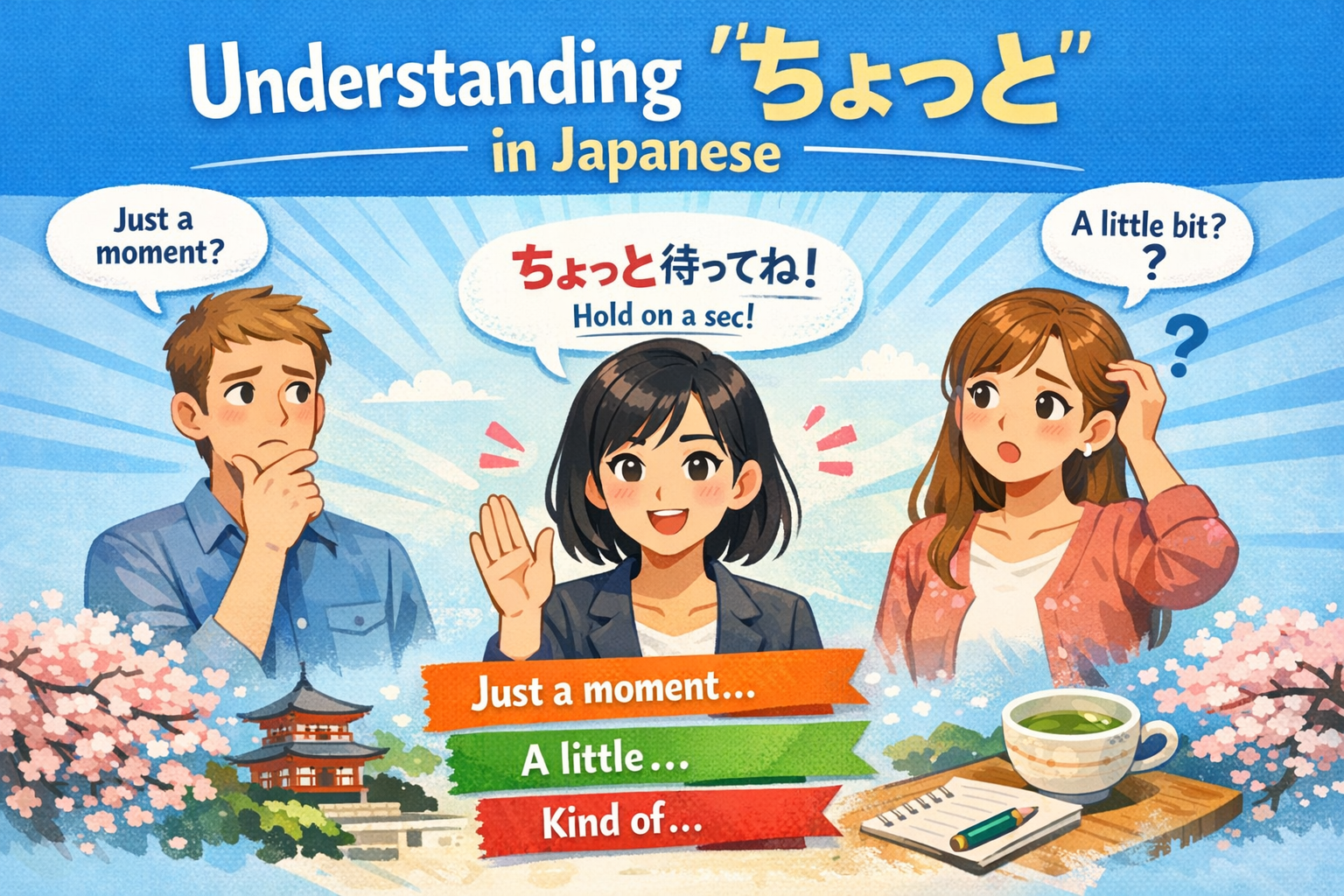
Introduction
As a Japanese person, I use the word “Chotto” almost every day.
Here are some common sentences we use in daily life:
ちょっとだけそのお菓子ちょうだい
Chotto dake, can I have some of those snacks?
楽しんで!じゃあちょっと、私は先に行くね
Have fun! Jaa chotto, I’ll go ahead.
ちょっと!何してるの!?
Chotto! What are you doing!?
As you can see, “Chotto” has multiple meanings depending on the situation.
In sentence ①, “Chotto” means “a little.”
In sentence ②, it works like “well…” or “you know,” and does not have a strong meaning—it simply creates a natural pause in conversation.
In sentence ③, it is used like “Come on!” or to call someone’s attention in surprise.
What Does “Chotto” Mean?
As a Japanese person, I don’t think of “Chotto” as one word with one meaning.
Instead, it is a very flexible expression that changes depending on context.
Common meanings of Chotto:
- A little
- Well… / you know…
- Hey! / come on!
- A soft way to say “no”
👉 The key idea is:
“Chotto” adjusts the tone of the conversation rather than giving a fixed meaning.
Why Is “Chotto” So Confusing?
Many English learners think:
👉 “Chotto = a little”
But as a Japanese speaker, I can say this is only one part of it.
The real reason it’s confusing:
- It has multiple meanings
- It is often used without a clear definition
- It depends heavily on:
- tone
- situation
- relationship
In English, words usually have clear meanings.
In Japanese, we often use words like “Chotto” to make communication softer and more natural.
Different Meanings of “Chotto” in Context
1. Chotto = “A Little”
This is the most basic meaning.
Example:
Chotto dake matte
→ Wait a little
Chotto tabetai
→ I want to eat a little
👉 This usage is easy and direct.
2. Chotto = A Natural Pause (“Well…”)
As a Japanese person, I often use “Chotto” when I need a moment to think or soften what I say.
Example:
Jaa chotto, saki ni iku ne
→ Well, I’ll go ahead
👉 Here, “Chotto” doesn’t have a strong meaning.
It simply makes the sentence sound more natural and less abrupt.
3. Chotto = Calling Attention (“Hey!” / “Come on!”)
We also use “Chotto” to react emotionally.
Example:
Chotto! Nani shiteru no!?
→ Hey! What are you doing!?
👉 This usage expresses:
- surprise
- annoyance
- urgency
Chotto as a Soft Way to Say “No”
This is one of the most important uses.
As a Japanese person, I can tell you that we often avoid saying “No” directly.
Instead, we say:
👉 “Chotto…”
Example:
Friend: Want to go out tonight?
You: Chotto…
👉 This usually means:
“I don’t want to, but I don’t want to say no directly.”
Why do we do this?
In Japan, we value:
- politeness
- harmony
- avoiding conflict
So instead of saying:
❌ “No, I don’t want to go”
We say:
👉 “Chotto…” (and let the other person understand)
Real-Life Conversation Examples
At Work
Coworker: Can you finish this today?
You: Chotto muzukashii desu…
👉 Meaning: “That might be difficult” (soft refusal)
With Friends
Friend: Want more food?
You: Chotto…
👉 Meaning: “I’m okay / I don’t need more”
Making Plans
Friend: Let’s travel this weekend!
You: Chotto ne…
👉 Meaning: “Hmm… probably not”
Casual Situation
Friend: Wait here!
You: Chotto matte!
→ “Wait a second!”
Comparison with English
| Japanese | Possible English Meaning | Notes |
|---|---|---|
| Chotto | a little / well / hey / no | depends on context |
Key Difference:
In English:
- Words have clearer meanings
In Japanese:
👉 “Chotto” changes meaning based on the situation
Tips to Understand “Chotto” Naturally
1. Focus on context
Ask yourself:
- Is this a request?
- Is this a reaction?
- Is this a refusal?
2. Pay attention to tone
- Soft tone → hesitation or refusal
- Strong tone → surprise or emotion
3. Watch body language
As a Japanese person, I can say:
👉 Body language often explains the meaning of “Chotto”
4. Don’t translate directly
❌ Chotto = a little (always)
👉 This is incorrect
✔ Think: “What is the speaker trying to do?”
SEO-Friendly Title Ideas
- What Does Chotto Mean? (Japanese Meaning Explained)
- Chotto Meaning: Why It Can Mean “No” in Japanese
- Chotto Japanese Meaning: A Complete Guide for Beginners
- Why Japanese Say “Chotto” Instead of “No”
Final Summary
Let’s review the key points:
- Chotto has many meanings
- It can be:
- “a little”
- a pause word
- an emotional reaction
- a soft “no”
- The meaning depends on:
- context
- tone
- situation
👉 The most important thing:
Don’t try to translate “Chotto.” Understand how it’s used.
As a Japanese speaker, “Chotto” feels completely natural to me.
But once you understand how it works, your Japanese will sound:
- more natural
- more polite
- more native-like
Next time you hear “Chotto…”, don’t panic.
Just think:
👉 “What does this situation mean?”


コメント