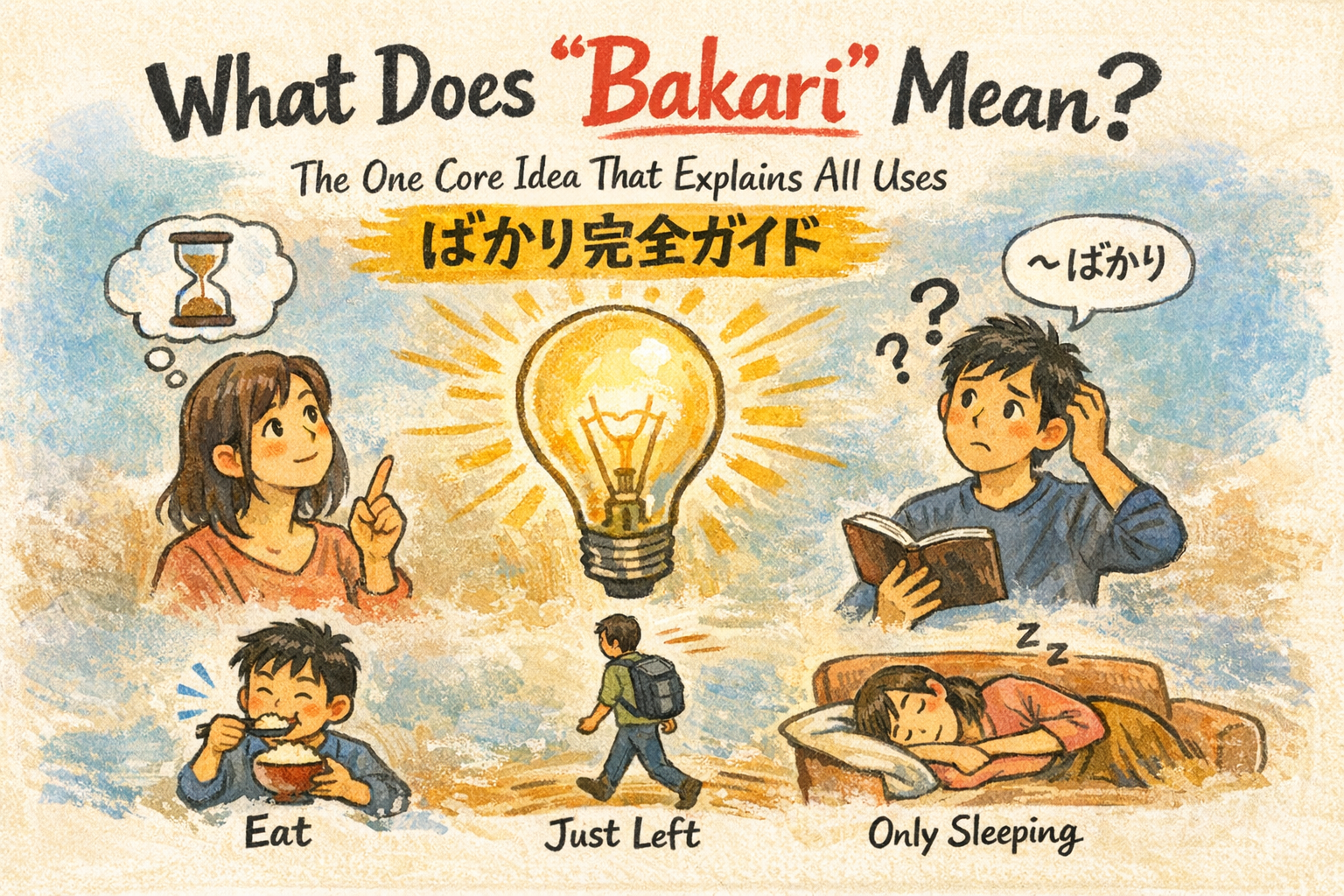
“Bakari (ばかり)” basically means: something is limited to, biased toward, or overly focused on one thing.
If you remember only this idea, you can understand most uses of “bakari” without memorizing dozens of separate rules.
- Why I’m Writing This
- The Core Image: “Limited” or “Biased”
- Core Usages Explained Simply
- “ばっかり” — The Casual Version
- A Hidden Nuance: Slightly Negative or Critical
- Common Mistake Learners Make
- Similar Expressions (Very Important for Natural Japanese)
- When Should You Use “Bakari”?
- Practical Learning Strategy
- Final Summary
Why I’m Writing This
While having everyday conversations in Japan, I noticed something surprising: I use “bakari” very frequently without even thinking about it.
That realization made me understand why so many learners struggle with it. On the surface, it looks like a grammar point with many unrelated meanings. In reality, it’s one simple idea used in different situations.
The most effective way to learn it is:
- Understand the core image: “limited / biased”
- Then look at real examples
The Core Image: “Limited” or “Biased”
“Bakari” describes a situation where something is:
- concentrated on one thing
- repeated excessively
- lacking balance
Sometimes it’s neutral. Sometimes it carries a slightly negative nuance like “too much” or “not balanced.”
This single idea explains almost every usage.
Core Usages Explained Simply
1. Noun + ばかり (only / nothing but)
- パンばかり食べている(pan bakari tabete iru)
→ I eat nothing but bread
This means your behavior is limited to one thing.
This using is the most common one.
It doesn’t always mean 100%, but it feels that way.
2. Verbて + ばかりいる (always doing)
- 遊んでばかりいる (asonde bakari iru)
→ He is always playing
This expresses repetition with imbalance.
It often implies that something else should be happening.
3. た + ばかり (just did)
- 今来たばかり(ima kita bakari)
→ I just arrived
This use is slightly different, but still connected.
You are in a state very close to that action, almost “limited” to that moment.
4. ばかりに (because of — negative result)
- 知らなかったばかりに失敗した(shiranakatta bakari ni sippai shita)
→ I failed just because I didn’t know
This highlights a single cause.
The nuance is often regretful.
5. ばかりで (only… and nothing else)
- 文句ばかりで何もしない(monku bakari de nani mo shinai)
→ He does nothing but complain
This shows imbalance — one thing dominates everything.
“ばっかり” — The Casual Version
In real conversations, you will often hear:
- ばっかり instead of ばかり
Example:
- パンばっかり食べてる
The meaning is identical. The difference is tone:
- ばかり → neutral
- ばっかり → casual, spoken
If you watch anime or talk with friends, you’ll hear “ばっかり” very often.
But note you can’t use “ばっかり” in formal situations.
A Hidden Nuance: Slightly Negative or Critical
“Bakari” is not always neutral. It often carries a subtle criticism.
For example, I often heard things like this from my mother:
- 「またお菓子ばっかり食べているね」
- 「言い訳ばっかり」
These don’t just describe repetition. They imply:
- “too much”
- “you shouldn’t be doing only that”
This indirect criticism reflects a broader pattern in Japanese communication. Instead of saying something directly like “Stop that,” people often point out imbalance.
So “bakari” can function as a soft way to criticize.
So why Japanese say something indirectly? It is related to our culture which you can learn from other article like this!

Common Mistake Learners Make
Many learners try to:
- memorize each grammar pattern separately
- translate each use differently
This creates unnecessary confusion.
Instead, always return to one question:
“What is being over-focused or limited here?”
That question will guide your understanding.
Similar Expressions (Very Important for Natural Japanese)
To really master “bakari,” you should compare it with similar expressions.
1. だらけ (full of — usually negative)
- ミスだらけ → full of mistakes
- ホコリだらけ → covered in dust
Difference from bakari:
- ばかり → biased toward something
- だらけ → completely filled with something (often visibly negative)
“Darake” is stronger and more clearly negative.
2. しか (only — used with negatives)
- 100円しかない
→ I only have 100 yen
Difference from bakari:
- ばかり → focus/imbalance
- しか → limitation with a feeling of insufficiency
“Shika” often implies “and that’s not enough.”
3. だけ (simple “only”)
- パンだけ食べる
→ I eat only bread
Difference:
- だけ → neutral restriction
- ばかり → suggests repetition or imbalance
“Bakari” feels more emotional or subjective.
When Should You Use “Bakari”?
Use “bakari” when you want to express:
- repetition
- imbalance
- slight criticism
- focus on one thing
Avoid it when you just want a neutral “only.” In that case, “だけ” is often better.
Practical Learning Strategy
To truly master “bakari,” don’t rely on memorization alone.
Instead:
- Notice it in real conversations
- Ask “What is being over-focused?”
- Pay attention to tone (neutral vs critical)
You will start to feel the nuance naturally.
Final Summary
“Bakari” may seem complex, but everything comes from one simple idea:
Something is limited, biased, or overly focused on one thing.
Once you understand this, the different patterns stop feeling random.
Instead, they become variations of the same concept.
And more importantly, you’ll start to notice something:
Native speakers use “bakari” far more often than textbooks suggest.
When you begin to recognize that pattern, your Japanese will start to sound much more natural.
You can learn more about Japanese from here!



コメント