Conclusion
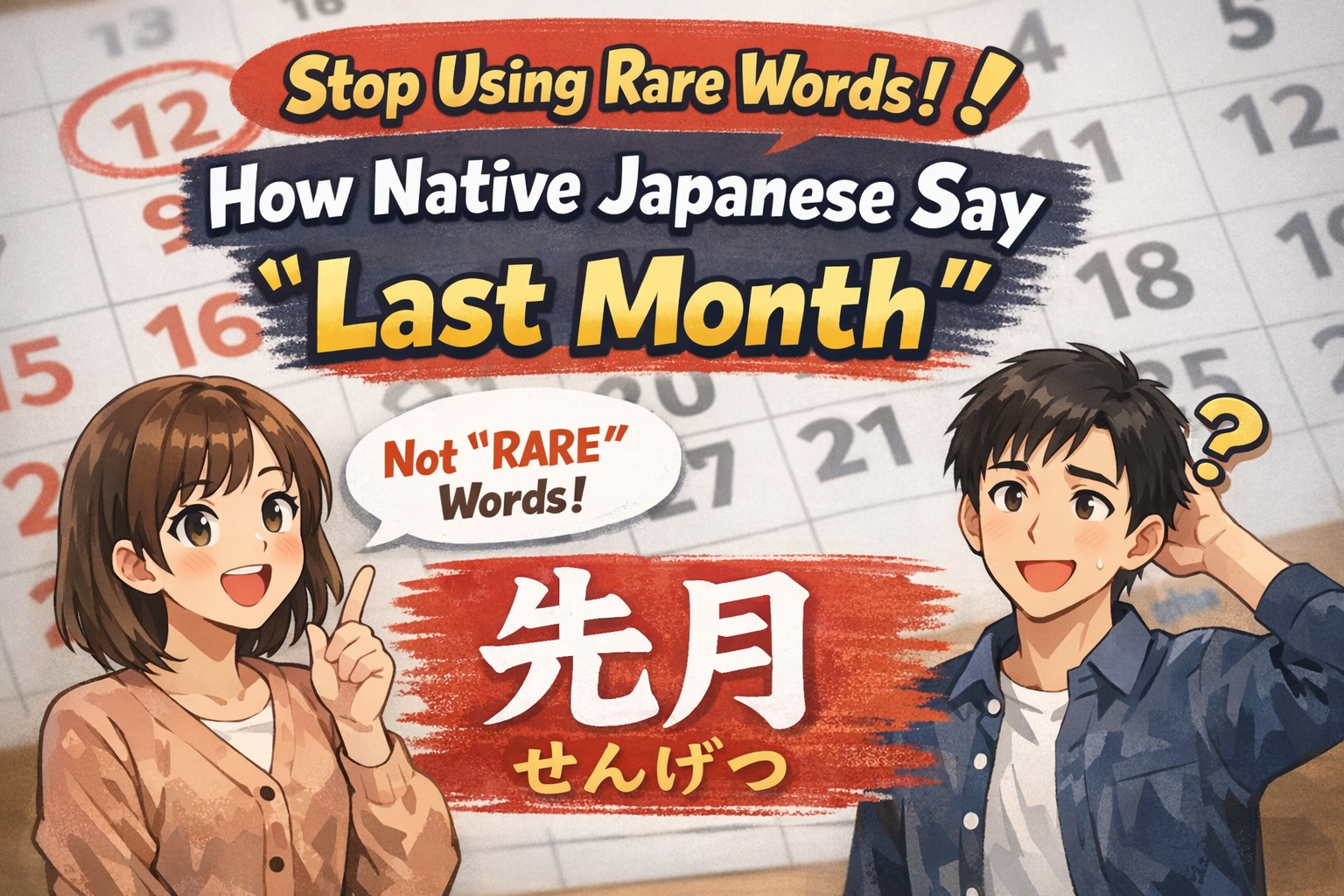
If you want to say “last month” in natural Japanese, use sengetsu (先月) or ikkagetsu mae (1カ月前).
These are the most common and natural expressions in everyday conversation. Other words like zengetsu (前月) or sakuzuki (昨月 / 去月) exist, but they are limited to specific contexts such as writing, business, or older usage.
Why This Topic Confuses Learners
You may have seen multiple words for “last month,” such as:
- senshuu (先月)
- sakuzuki (昨月 / 去月)
- kyakuzuki (客月)
- zengetsu (前月)
- kougetsu (後月)
And wondered:
- What’s the difference?
- Which one should I actually use?
- Are some of these outdated?
The short answer: Most of these are not used in everyday conversation.
The Two Most Natural Expressions
1. Senshuu (先月) — The Standard
This is the most common way to say “last month.”
Used in:
- everyday conversation
- casual and polite speech
- general writing
Example:
- Senshuu Nihon ni ikimashita.
(先月日本に行きました。)
“I went to Japan last month.”
This is the default choice. If you are unsure, use this.
2. Ikkagetsu Mae (1カ月前) — Time-Based Expression
This literally means “one month ago.”
Used when:
- you want to emphasize time distance
- giving precise timelines
Example:
- Ikkagetsu mae ni koko ni kimashita.
(1カ月前にここに来ました。)
“I came here one month ago.”
Words You Might See but Rarely Hear
Sakuzuki / Kyogetsu (昨月 / 去月)
These are older or more formal ways to say “last month.”
- Rare in modern conversation
- Occasionally seen in formal writing or old texts
In daily life, they sound unnatural.
Kyakugetsu (客月)
This is extremely rare.
- Not used in modern conversation
- Mostly appears in historical or literary contexts
Most native speakers do not use this word at all.
Business and Written Context
Zengetsu (前月) — “Previous Month”
Used in:
- business reports
- formal writing
- data comparison
Example:
- Zengetsu to kurabete uriage ga agatta.
(前月と比べて売上が上がった。)
“Sales increased compared to the previous month.”
This is not used in casual conversation.
Atogetsu (後月) — “Next Month” (Opposite concept)
Although not “last month,” it often appears in the same discussions.
- Formal or written usage
- Not common in speech
Cultural Insight: Why So Many Words Exist
Japanese has multiple words for the same concept because of:
- historical layers (Chinese-influenced vocabulary vs native words)
- differences between spoken and written language
- strong separation between casual and formal expression
In modern Japanese, however, everyday speech favors simple and intuitive expressions like “senshuu.”
Real Usage Comparison
Natural conversation
- Senshuu isogashikatta.
(先月忙しかった。)
“I was busy last month.”
Business context
- Zengetsu no deta o bunseki shimashita.
(前月のデータを分析しました。)
“We analyzed last month’s data.”
Unnatural (in conversation)
- Sakuzuki isogashikatta.
→ Sounds outdated or unnatural
Common Mistakes
- Trying to use rare or “advanced-looking” words like kyakuzuki
- Using zengetsu in casual conversation
- Avoiding senshuu because it seems too simple
In reality, native speakers prefer the simplest option.
Key Takeaways
Senshuu (先月) is the most natural and commonly used expression.
Ikkagetsu mae (1カ月前) is useful for precise timing.
Zengetsu (前月) is used in business or formal writing.
Words like sakuzuki or kyakuzuki are rarely used in modern conversation.
Learn more about Japanese? See other articles!




コメント