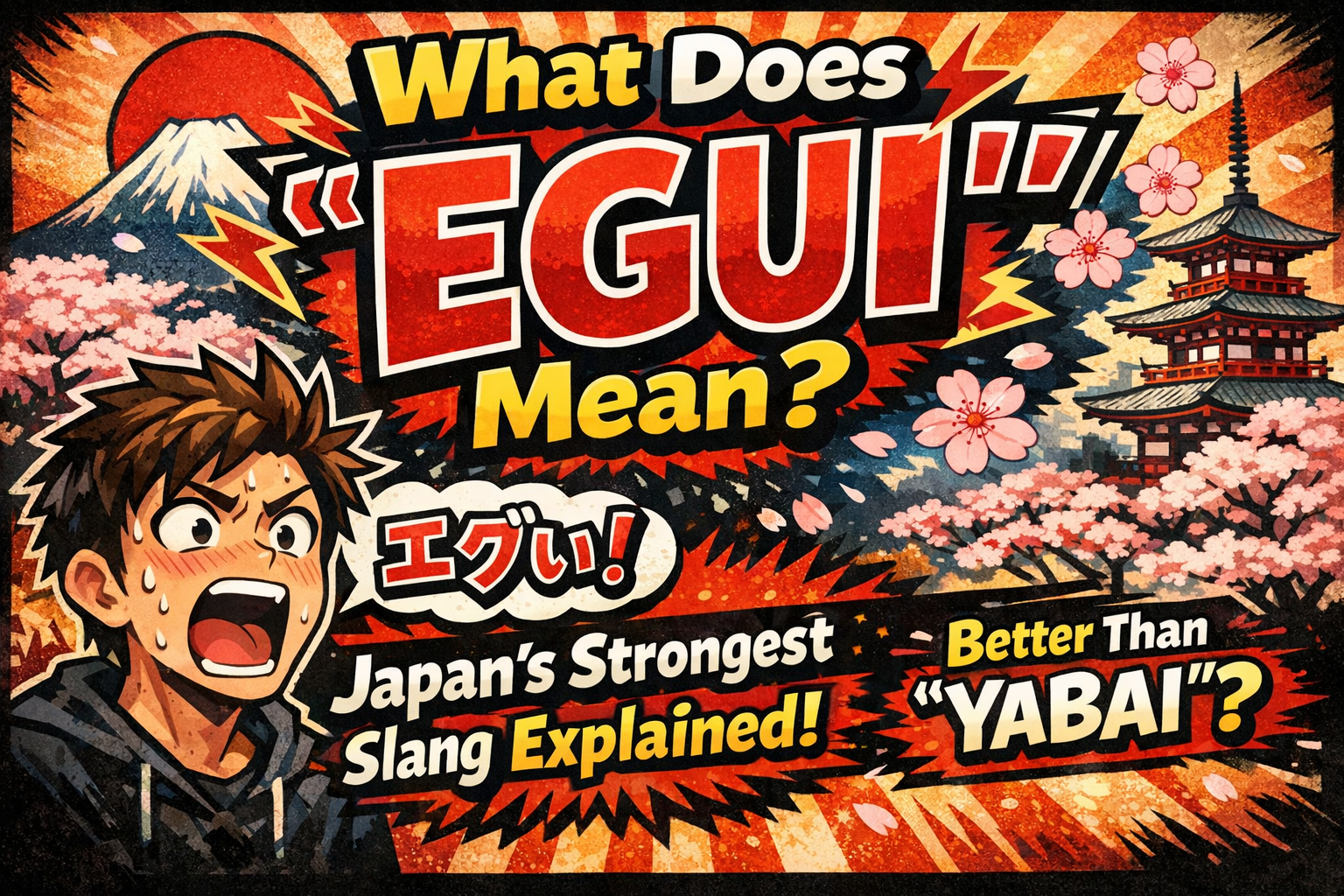
- Conclusion (Quick Answer)
- What “Egui” means
- Core Meaning (Important Explanation)
- How to pronounce “Egui” (えぐい)
- 💬 Example Sentences (Natural Usage)
- Common Mistakes (Very Important)
- Egui vs Yabai vs Sugoi
- Cultural Background (Why young people use it)
- When should you use “Egui”?
- Why you should learn “Egui”
- Final Takeaway
Conclusion (Quick Answer)
“Egui (えぐい)” is a Japanese slang word used to express strong surprise or intensity—similar to “yabai,” but often stronger and more shocking.
It can describe something extremely good, bad, impressive, or overwhelming.
If you don’t know Yababi, check this!

What “Egui” means
“Egui” is a popular slang word among young people in Japan.
It is used when something feels:
- Extremely impressive
- Shockingly good or bad
- Overwhelming or intense
In English, it’s closest to:
- “insane”
- “crazy”
- “wild”
- “intense”
Core Meaning (Important Explanation)
- “Egui” is often used to express surprise and has a similar meaning to “sugoi” (amazing) or “yabai” (crazy).
- It can be used as “egui,” but it is also often used in a shorter, more casual form like “egg.”
- Originally, “egui” meant something grotesque or harsh, but among young people in Japan today, it has a similar meaning to “yabai.” However, it gives a stronger impression than “yabai.”
In short:
“Yabai” = crazy
“Egui” = insanely crazy
You should check the meanings of “Sugoi” and “Yabai”!
How to pronounce “Egui” (えぐい)
“Egui” is pronounced like:
eh-goo-ee
However, in casual speech:
- It often sounds like “egui” → “egui” (fast)
- Or even shortened to “egg”
Why does it sound like “egg”?
Japanese tends to drop vowels in fast speech.
“e-gu-i” → “egui” → “egg”
That’s why you’ll often hear:
- “That’s egg!” (meaning “That’s insane!”)
💬 Example Sentences (Natural Usage)
- This ramen is egui.
→ This ramen is insanely good. - His salary is egui.
→ His salary is ridiculously high. - That goal was egui.
→ That goal was unreal. - This workload is egui.
→ This workload is insane (too much). - The price is egui.
→ The price is crazy (expensive). - Her skills are egui.
→ Her skills are insane.
Common Mistakes (Very Important)
1. Using it in formal situations
“Egui” is slang.
Don’t use it:
- At work meetings
- With your boss
- In formal writing
You want to know more words like this, check it!

2. Using it with older people
Many older Japanese people:
Don’t use it or may not understand it well
3. Assuming it’s always positive
“Egui” can be:
- Positive → amazing
- Negative → terrible
Context decides the meaning (just like “yabai”)
Egui vs Yabai vs Sugoi
| Word | Strength | Nuance |
|---|---|---|
| Sugoi | Medium | Basic “amazing” |
| Yabai | Medium–High | Casual, flexible |
| Egui | High | Strong, intense, impactful |
If you want to sound more native:
- Start with “sugoi”
- Then “yabai”
- Then level up to “egui”
Cultural Background (Why young people use it)
“Egui” became popular through:
- Social media (X, TikTok)
- YouTube reactions
- Casual conversations among young people
Japanese youth culture values:
- Strong emotional reactions
- Short, punchy expressions
“Egui” fits perfectly:
・Short
・Powerful
・Easy to react with
When should you use “Egui”?
Use it when you feel:
- Shocked
- Impressed
- Overwhelmed
Example situations:
- Watching sports
- Seeing expensive items
- Eating amazing food
- Hearing surprising news
Why you should learn “Egui”
- Very common in modern Japanese
- Helps you understand native conversations
- Makes your Japanese sound natural and current
Many learners know “yabai”
But few use “egui” correctly
That’s your chance to stand out
Final Takeaway
If you already know “yabai,”
“egui” is your next step.
It’s stronger, sharper, and more expressive.
Use it right, and people will think:
“Your Japanese is really natural.”


コメント