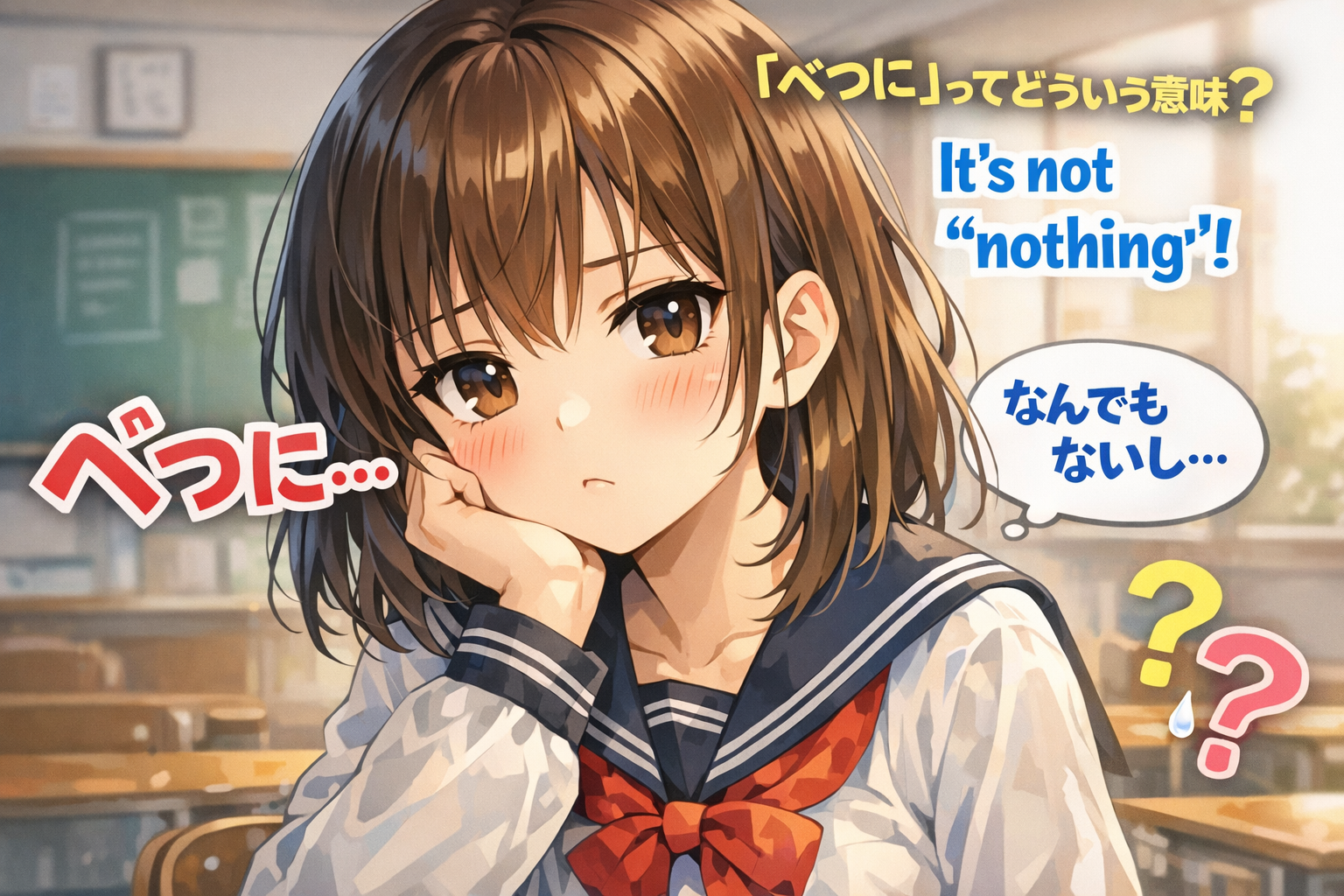
Conclusion (Quick Answer)
“Betsuni (別に)” means “nothing” or “not really,” but it is often used to hide true feelings. In anime and real conversations, it frequently appears after someone does something meaningful but pretends it was not.
If you’re learning Japanese slang, you’ve probably also heard words like “yabai” or “egui.”
Check these guides to understand the full nuance of modern Japanese:


What “Betsuni” really means
At a basic level, “betsuni” is translated as:
- “Nothing”
- “Not particularly”
- “Not really”
However, this direct translation is often misleading. In real usage, the word carries emotional nuance and is highly dependent on context and tone.
Core Meaning (Important Explanation)
“Betsuni,” like “nandemonai” (なんでもない), is used to indicate that there is no particular meaning behind one’s words or actions.
However, in anime and real-life situations, it is often used after doing or saying something that actually has meaning, in order to hide one’s true intention.
In short, “betsuni” often means “It’s nothing”… but in reality, it is not.
“Betsuni” is often confused with other ambiguous Japanese expressions.
For example:

Anime Usage (with famous examples)
“Betsuni” is commonly used by characters who avoid showing their emotions directly. This is especially common in popular mainstream anime.
Example 1
“Betsuni… I wasn’t worried about you.”
Source: “Neon Genesis Evangelion” (character: Asuka Langley)
Meaning: The character was clearly worried but refuses to admit it.
Example 2
“Betsuni. It’s not like I did it for you.”
Source: “Naruto” (character: Sasuke Uchiha)
Meaning: The character takes action that shows care, but verbally denies it.
Example 3
“Betsuni… it’s not a big deal.”
Source: “Attack on Titan” (character: Mikasa Ackerman)
Meaning: The character downplays something emotionally significant.
These examples highlight a key pattern:
“Betsuni” is used to create distance between true feelings and spoken words.
Real-Life Examples
Why did you help me?
→ Betsuni.
→ “No reason.” (but there may be one)
Do you like him?
→ Betsuni…
→ “Not really…” (possibly hiding feelings)
Are you upset?
→ Betsuni.
→ “No.” (but tone may suggest otherwise)
Key Nuance
“Betsuni” can express:
- Emotional avoidance
- Indifference (real or fake)
- Hidden intention
The meaning depends heavily on tone, facial expression, and situation.
Common Mistakes
1. Assuming it always means “nothing”
In many cases, it actually means:
“I don’t want to explain” or “I’m hiding something.”
2. Using it in polite situations
If someone thanks you and you reply “betsuni,” it can sound cold or dismissive.
Betsuni vs Nandemonai
| Word | Meaning | Nuance |
|---|---|---|
| Nandemonai | Nothing | Neutral, honest |
| Betsuni | Not really | Often hides intent |
“Nandemonai” usually means truly nothing.
“Betsuni” often suggests there is something, but the speaker chooses not to reveal it.
Want to understand more subtle differences like this?
You might also like:

How to pronounce “Betsuni”
Pronunciation: beh-tsu-nee (べつに)
In casual speech, it may sound like “bets’ni.”
When should you use “Betsuni”?
Use it when you want to:
- Downplay your actions
- Avoid giving details
- Hide your feelings
It is most appropriate in casual conversations.
Why this word matters
“Betsuni” is extremely common in:
- Anime
- Everyday conversations
- Emotionally subtle situations
Understanding it helps you interpret what people really mean, not just what they say.
Final Takeaway
“Betsuni” is not just “nothing.”
It often means:
“I have a reason, but I won’t tell you.”
This hidden layer is what makes it one of the most important words for understanding real Japanese communication.
Continue learning real Japanese expressions:



コメント