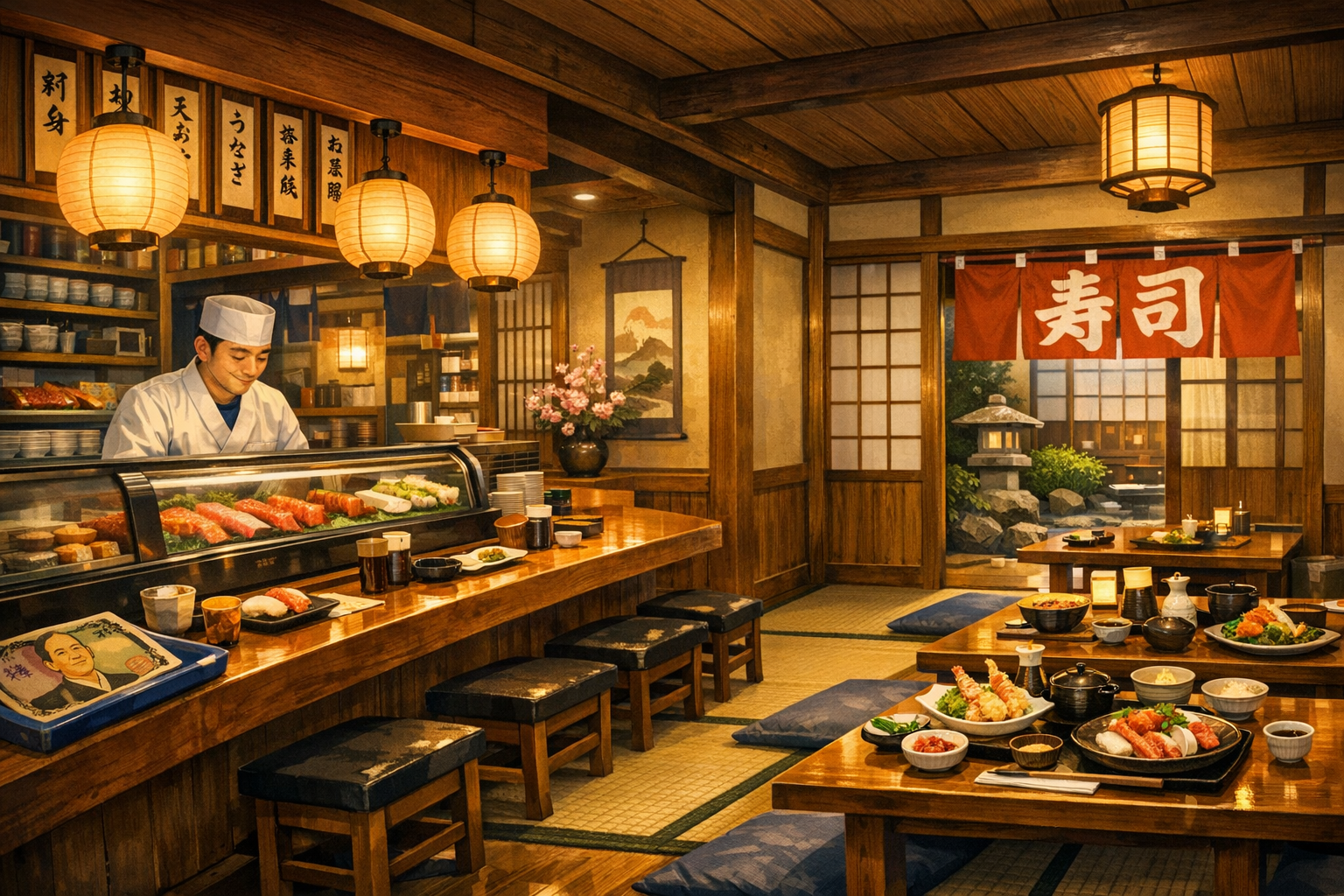
Eating at restaurants in Japan can feel intimidating at first — but the truth is simple:
you only need a few key Japanese phrases to order food smoothly and confidently.
As a Japanese person, I can tell you that restaurant interactions in Japan follow a clear pattern. Once you understand the common phrases, you’ll feel much more comfortable dining anywhere — from small local shops to popular restaurants.
- ✅ Essential Japanese Phrases (Quick List)
- 1. Calling the Staff – Sumimasen (すみません)
- 2. Asking for a Menu – Menu o kudasai (メニューをください)
- 3. Asking for Recommendations – Osusume wa nan desu ka? (おすすめは何ですか?)
- 4. Ordering Food – Kore o onegaishimasu (これをお願いします)
- 5. Asking for Water – Mizu o kudasai (水をください)
- 6. Saying No Politely – Daijoubu desu (大丈夫です)
- 7. Asking for the Bill – Okaikei onegaishimasu (お会計お願いします)
- 8. Always Say Thank You – Arigatou gozaimasu (ありがとうございます)
- 💡 Real Experience from a Japanese Perspective
- ⚠️ Common Mistakes Travelers Make
- ✅ Conclusion
✅ Essential Japanese Phrases (Quick List)
Here are the must-know phrases you’ll actually use at restaurants in Japan:
- Sumimasen (すみません) – Excuse me (to call staff)
- Menu o kudasai (メニューをください) – Menu, please
- Osusume wa nan desu ka? (おすすめは何ですか?) – What do you recommend?
- Kore o onegaishimasu (これをお願いします) – I’ll have this
- Mizu o kudasai (水をください) – Water, please
- Daijoubu desu (大丈夫です) – No, thank you / I’m okay
- Okaikei onegaishimasu (お会計お願いします) – Check, please
- Arigatou gozaimasu (ありがとうございます) – Thank you
💡 These phrases cover everything: calling staff, ordering, asking questions, and paying.
1. Calling the Staff – Sumimasen (すみません)
In Japan, you usually call the staff instead of waiting for them.
Example:
- Sumimasen! (すみません!) – Excuse me!
Japanese perspective:
This is completely normal. Saying it clearly (not too quietly) helps staff notice you quickly.

Also, it’s better to call the staff only after you’ve decided what to order. A friend of mine who used to work part-time at a restaurant told me that they didn’t like being called when customers hadn’t decided yet.
If you want to learn different ways to use Sumimasen, check next article!
2. Asking for a Menu – Menu o kudasai (メニューをください)
Some restaurants give menus automatically, but not always.
Example:
- Sumimasen, menu o kudasai (すみません、メニューをください) – Excuse me, menu please
Recently, more restaurants in Japan use QR codes for ordering, so it’s a good idea to check that in advance.
3. Asking for Recommendations – Osusume wa nan desu ka? (おすすめは何ですか?)
If you’re not sure what to order, this is the best phrase.
Example:
- Osusume wa nan desu ka? – What do you recommend?
Japanese perspective:
Staff often suggest popular or seasonal dishes. It’s a great way to experience authentic food. Surprisingly, staff are not often spoken to this way, so they’ll likely appreciate it!
4. Ordering Food – Kore o onegaishimasu (これをお願いします)
The easiest way to order is just pointing and saying this.
Example:
- Kore o onegaishimasu – I’ll have this
Tip:
Even Japanese people use this simple phrase — no need for complicated sentences.
5. Asking for Water – Mizu o kudasai (水をください)
Water is usually free in Japan, but sometimes not automatically served.
Example:
- Mizu o kudasai – Water, please
It’s free in Japan!
6. Saying No Politely – Daijoubu desu (大丈夫です)
You’ll often need to refuse something politely.
Example:
- Daijoubu desu – No, thank you
Japanese perspective:
This phrase is very common. It can mean “I’m okay” or “No,” depending on context.
7. Asking for the Bill – Okaikei onegaishimasu (お会計お願いします)
In Japan, you usually go to the cashier instead of paying at the table, but this phrase is still useful.
Example:
- Okaikei onegaishimasu – Check, please
8. Always Say Thank You – Arigatou gozaimasu (ありがとうございます)
Ending your meal with a polite “thank you” leaves a great impression.
Japanese perspective:
Even a simple smile and arigatou gozaimasu makes the interaction warmer.

💡 Real Experience from a Japanese Perspective
As someone living in Japan, I often see travelers hesitate to call staff or feel nervous about ordering.
But here’s the reality:
👉 Restaurant conversations are very predictable.
Usually, it’s just:
- Call staff
- Order
- Eat
- Pay
Once you know the key phrases, everything becomes easy.
⚠️ Common Mistakes Travelers Make
- Not calling staff (sumimasen) → you might wait too long
- Overthinking grammar → simple phrases are enough
- Not saying thank you → small but noticeable
✅ Conclusion
You don’t need fluent Japanese to enjoy restaurants in Japan.
Just remember these key phrases:
- Sumimasen
- Kore o onegaishimasu
- Daijoubu desu
- Okaikei onegaishimasu
- Arigatou gozaimasu
With these, you can confidently order food anywhere in Japan.
💡 Pro Tip:
Speak clearly, smile, and keep it simple — Japanese staff will appreciate your effort.
コメント